Art forms rooted in China's rich intangible cultural heritage not only survive -- they evolve, speaking in new voices, across new stages, to new generations.
by Li Xirui
NEW YORK, Aug. 7 (Xinhua) -- A sunlit loft in Long Island City houses a miniature world stitched together by time. Hand-carved puppets, silk costumes and calligraphy brushes sit beside projectors, laptops and stage lights.
This is the creative home of the Chinese Theatre Works (CTW), where centuries-old Chinese puppetry traditions are reimagined through experimental theater to connect with contemporary American audiences.
Founded by Chinese opera performer Kuang-Yu Fong and American avant-garde puppeteer Stephen Kaplin, the CTW has become a rare cultural laboratory. Here, art forms rooted in China's rich intangible cultural heritage not only survive -- they evolve, speaking in new voices, across new stages, to new generations.
VOICES EMERGING
"Puppetry is very playful," said Charlie Santos, 29, a newcomer to Chinese puppetry who grew up with Western community theater. "It brings me back to being a kid, playing with toys, animating them in your imagination, and creating little worlds."
The world Santos now builds is steeped in Chinese tradition. His journey into puppetry began online, when a glimpse of the CTW's workshop piqued his curiosity. He started out as a volunteer at their shows, gradually immersing himself in the stylized movements, rhythms, and discipline of Chinese performance. The leap from spray-painted sets to shadow puppets was vast -- but for Santos, that gap became a bridge.
"The theater I grew up in was very much like everything was fresh and new. Anyone can come in and do something," he said. "At CTW, there is a deep respect for tradition, and that is humbling. These art forms have long histories, and honoring that legacy is essential."
"There is this beautiful culture that I have been learning so much about and getting to sink my teeth into. On the other hand, I am not a part of it," he said. "In that respect, it has been a really good place for me, pushed me outside of that comfort zone."
Santos said he likes to be an "outsider."
"Traditions need voices that are not bound by regulation or convention. I think there is value in contributing a different perspective, as long as it's rooted in respect," he said.
While Santos represents new energy and a break with tradition, Chen Xiuyuan, a graduate student at New York University Tisch School of the Arts, stands for a young generation willing to promote their cultural heritage.
"There are fewer and fewer young people who devote themselves to this traditional art form with nothing but passion, like people who perform, promote and preserve it with their own hands for decades," he said.
Chen did not step directly onto the stage -- he stepped into the past, digitizing decades-old archival footage and piecing together fragments of history.
"Since 1995, they have recorded an extraordinary collection of material on tape -- rich in content, varied in style," he recalled. "The formats were outdated, the equipment unreliable. But the stories they held -- those were priceless."
STAGES REIMAGINED
"This is the new energy Chinese art needs," said Fong, executive director and co-founder of the CTW. "We need someone who is not held back by tradition. What we are doing is a mix -- we keep the traditional but blend it with contemporary styles."
That spirit of experimentation has also shaped Fong's own journey within the organization.
"Over time, I began to understand the many layers of 'role-playing' in artistic work," she said. "I am a producer, a stage director and an educator. I've transitioned from being an artist to becoming an organizer."
For Fong, who was trained in classical Chinese opera, promoting Chinese theater in America is not about a one-time performance -- it is about cultivating a lasting cultural presence through thoughtful evolution. Her team has consistently sought out emerging voices like Santos and Chen, who navigate both Chinese and Western sensibilities.
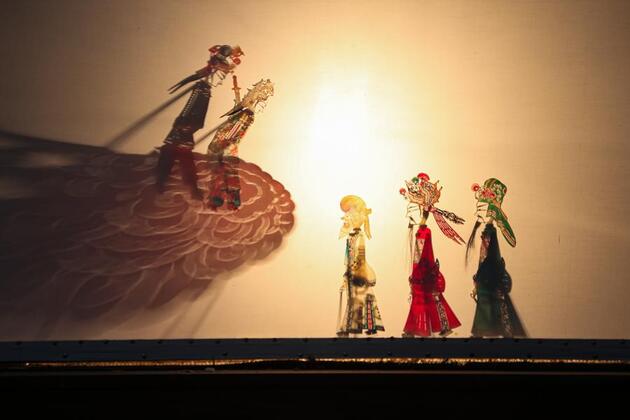
This evolution also means experimentation. Traditional shadow puppetry is reimagined through projections and live silhouettes. Scripts draw on Chinese myths, while dialogue often unfolds in English. In "The Legend of the White Snake," ancient folklore merges with modern multimedia to create a visual language that transcends cultures.
"This is exactly the direction we are exploring: using Western technical vocabularies to reinterpret Chinese tradition, and crafting a new kind of contemporary performance," she said.
"We want to emphasize what I call a 'serious playfulness' in our theater work. In English, 'play' means both performance and game," she added. "We take our work seriously -- but we also believe art should be fun, organic and alive."
BRIDGING GENERATIONS
For Kaplin, the CTW's co-founder, this blend of old and new is not only artistic, but also personal. Trained in American experimental theater, he once saw Chinese traditional arts as "from another planet." But after meeting Fong, that distance became the basis for collaboration -- and marriage.
"They are very different," he said. "But you find ways to bridge them."
Kaplin fell in love with puppetry due to its fusion of writing, design and performance, viewing it as a serious artistic medium capable of deconstructing traditional theater. His mission to reframe puppetry got fresh impetus when he and Fong began collaborating.
Kaplin said that his collaboration with Fong is fun, as Chinese traditional theater performers usually follow strict movements to make the art look professional and authentic, while Western artists are more casual.
The couple began merging puppetry with Chinese culture, using comedy to tell stories of immigration, shadow puppetry to express contemporary struggles, and a handmade toy theater to explore everyday life.
"We started doing Monkey (the character from the Chinese novel "Journey to the West") in New York," he said.
It was not a mere adaptation, but a cultural reinterpretation. Instead of simply replicating Chinese art, their goal was to reinterpret it in ways that resonate with Western audiences.
While traditional Chinese art values inheritance, American avant-garde theater emphasizes experimentation. Kaplin said it is still important to ensure authenticity and maintain elements from the original art.
For Kaplin and Fong, preserving tradition is not about resisting change -- it is about guiding it, and resurrecting old art forms through experimentation, collaboration and cross-cultural imagination.
"Don't throw out the past. Yes, there's all this incredible technology here, but it has its limits... Think about Chinese culture, how long it's been around. We should make good use of it," he said.



 Share
Share
 Tweet
Tweet
 Share
Share
 Flip
Flip
 Email
Email